

What is an Automotive Lighting System?
What is an Automotive Lighting System?
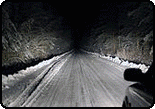
It is the part of the vehicle that includes lighting and warning systems, located at the front, sides, and rear of the vehicle. The purpose of this system is to provide sufficient illumination for the driver in low-light conditions, thereby enhancing visibility, and to convey information about the vehicle’s dimensions, position, location, direction of movement, and the driver’s intentions regarding lane changes and speed adjustments.
Front Automotive Lighting
Front Automotive Lighting
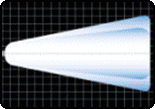
The vehicle’s front illumination is provided by the headlamps, which consist of both high-beam and low-beam lights. This system is further complemented by the fog lamps and turn signal lights
Emitted Light Color
Emitted Light Color
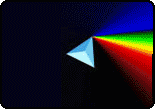
The type and intensity of light emitted by vehicle lamps were first standardized in 1949 by the Traffic Guidance Center of the Vina Assembly and later, in 1968, were broadly defined by the Traffic Guidance Center of the United Nations Assembly. With a few global and regional exceptions, it was determined that rear lamps must emit red light, side and warning lamps must emit yellow or amber light, and front lamps must emit white or optionally yellow light. Except for the lights on emergency vehicles, no other colors are permitted.
Head Lamp
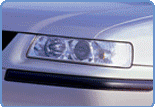
This lamp, located at the front of the vehicle, is designed to illuminate the road ahead during darkness or in rainy and snowy conditions. In English, the term “front light” is often used instead of “headlamp”, although “headlamp” is technically correct, while “front light” refers to the light emitted by the vehicle’s headlamp. A headlamp can be installed on a bicycle (using a battery or a small electric generator) as well as on many other vehicles, such as airplanes and trains, each of which has its own specific headlamp.
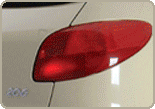
Tail Lamp
At night, the rear of the vehicle becomes visible through the tail lamps, also referred to as rear lights, stop lights, or rear illumination. Tail lamps must emit red light and are designed to illuminate whenever the vehicle’s front lights are on. Brake lights may be integrated within the tail lamps or installed separately at the rear of the vehicle. In the integrated setup, the brake light emits a lighter red, while the tail lamp emits a darker red. Tail and brake lights can operate independently, or a dual-intensity lamp may provide both functions. Global regulations define minimum intensity ratios for the two shades of red, ensuring that brake light illumination is never confused with tail light illumination.
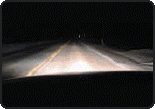
Low Beam
Low-Beam Headlamp (Dipped Beam or Passing Beam) provides sufficient illumination for the road ahead and the surrounding area without causing glare that would impair the vision of oncoming drivers. This beam is used to light the road when other vehicles are present in front of you. According to the global ECE regulations for headlamps, the beam is designed with a sharp, asymmetric cut-off to prevent excessive glare for oncoming drivers. In the North American SAE standard (FMVSS/CMVSS108), there is less emphasis on controlling glare.
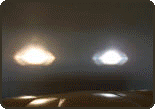
Hight Beam
High-Beam Headlamp (Driving Beam or Full Beam) emits a strong, focused light that can be very dazzling. Therefore, this beam is only suitable for use when the vehicle is traveling alone on the road, as it can impair the vision of oncoming drivers. According to global ECE regulations, high beams are permitted to have higher intensity compared to North American standards.
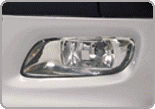
Fog Lamp
Fog Lamp emits a wide, horizontal, and sharply cut-off beam, and its light can be white or yellow. This lamp is intended for use at low vehicle speeds under adverse weather conditions such as rain, snow, fog, or dust, to increase illumination on the road surface. As a result, fog lamps are often used in place of the low-beam headlamps because they reduce light reflection from fog and snow. However, using fog lamps without low beams is generally against regulations.
When the driver’s visibility is not significantly reduced, the use of fog lamps is prohibited (for example, in the UK), because the glare can affect oncoming drivers and, on wet roads, excessive foreground illumination can reduce the driver’s own visibility. Due to misconceptions—such as the belief that fog lamps must always be yellow, and that any white light is a high beam—fog lamps and high beams are often confused. Automakers, aftermarket suppliers, and parts manufacturers frequently refer to these two lamps interchangeably.
In most countries, because foggy conditions are relatively rare, there is little strict requirement for using fog lamps. Consequently, turning them on is often for aesthetic purposes or as a substitute lighting option. Studies indicate that in North America, people tend to use fog lamps more frequently in normal weather than in rainy conditions.

Automotive turn Signal
n some vehicles, turn signal lamps distribute additional light in the direction of the vehicle’s movement when the vehicle is changing lanes or turning. This increased illumination is activated with the turn signal and provides continuous light. Additionally, these lamps may illuminate when the vehicle is reversing, as seen in vehicles from brands like Corvette and Saab.
North American technical standards for front and side turn signal lamps establish specific regulations. Traditionally, under ECE regulations, turn signals were prohibited; however, recent updates now allow their use only when the vehicle is traveling at speeds below 40 km/h.
Front Position Lamp
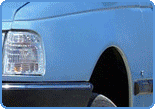
The visibility of a stationary vehicle at night is provided by the front position lamp, known as the “parking lamp” in North America, the “front side lamp” in the UK, and in other regions as the “position lamp” or “city lamp.” Despite the English term “position lamp,” it differs from the side turn signal, which will be described below.
In North America, the light emitted by the position lamp can be white, yellow, or amber, whereas in most parts of the world, this lamp must emit white light. The term “city lamp” originates from an obsolete practice of using these lamps instead of headlights in cities like Moscow, London, and Paris at night. Today, in most countries, the use of position lamps while driving is prohibited unless the headlights are also on.
Driving Lamp
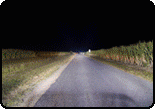
The term “driving lamp” originated when the first vehicles began operating at night, at a time when encountering an oncoming vehicle was rare. Only when two vehicles passed each other was the term “passing beam” or “low beam” used. The term “full beam” was used to describe the driving lamp, and these terms can still be found in ECE regulations, which do not differentiate between primary (mandatory) and auxiliary (optional) headlamps.